Craft Unbound Rotating Header Image

jewellery

Regine Schwarzer creates Royal Jewels unique to Australia

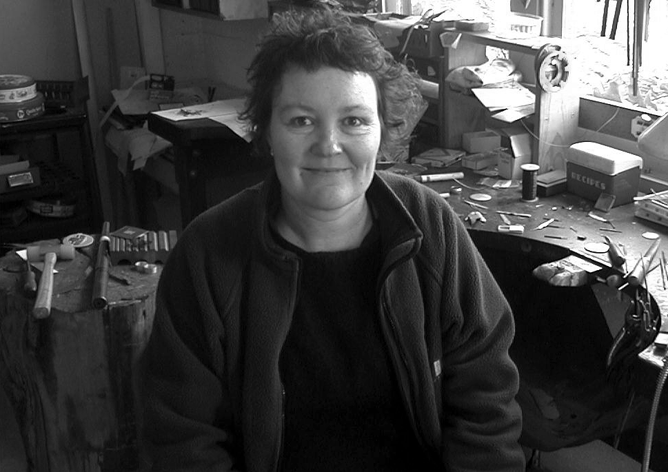
Regine Schwarzer

Regine Schwarzer

Born 1961 in Germany, Schwarzer grew up in Bavaria, training in jewellery making and metalwork at the Zeichenakademie Hanau one of the oldest training institutions in Europe. In 1993 she moved to Australia where she lives and works in the Adelaide Hills.

In the Australian outback she discovered her passion for the abundant gems and minerals she loves collecting on field trips. Inspired by the colours and structures of these minerals, she learned how to shape them and uses them often in her work.

Visual uniqueness gives value to common materials that are often overlooked or disregarded. By slicing into the materials I discover structures, patterns and colours, traces of their geological history hidden in the layers.

GeoMorphing, her latest body of work, is inspired by the crystalline formations of minerals which grow in a variety of different systems. By designing and constructing both jewellery and objects that reference and utilize gems and minerals she investigates the term precious as it is often attributed to certain materials.

Schwarzer holds a Masters Degree in Visual Arts and Design. She exhibits widely nationally and internationally, her work is included in many private collections and has been published in Crafts Arts International as well as 1000 rings, 500 Gemstone Jewels and 500 Silver Jewelry Designs by Lark books.

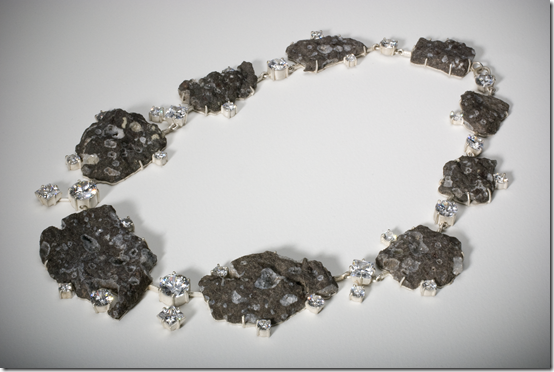
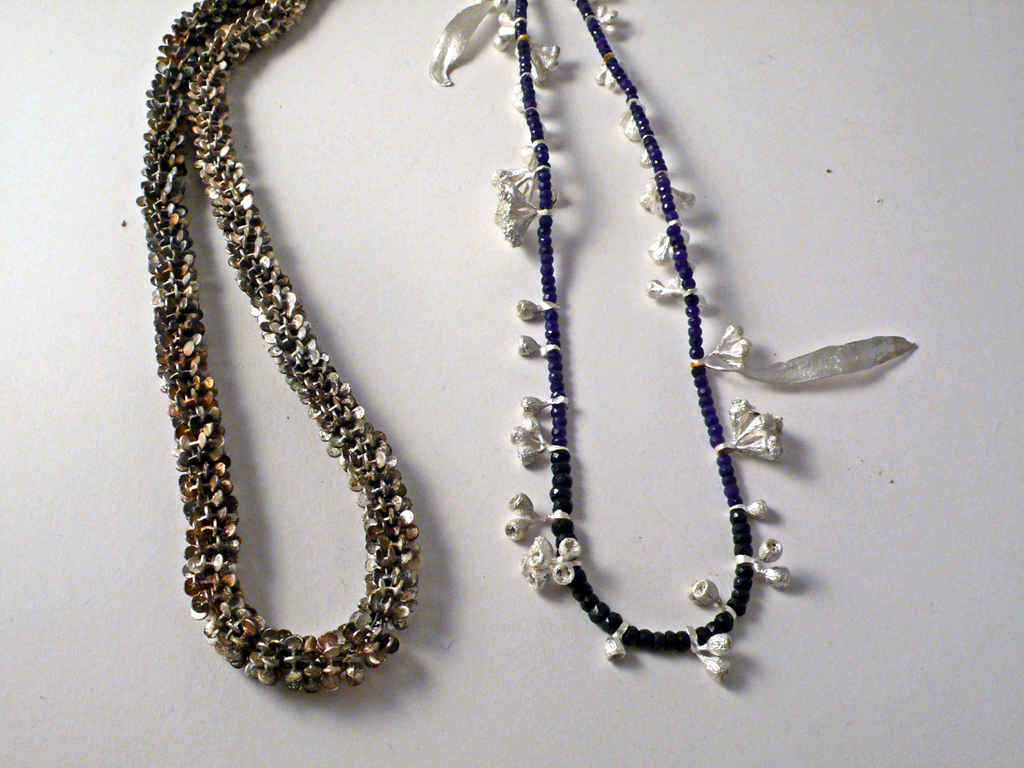
Regine Schwarzer 'Royal Jewels' Necklace, Royal Jewels, chabazite in basalt, cubic zirconia, sterling silver, 2008, 23 x 23 x 1.4 cm

Regine Schwarzer 'Royal Jewels' Necklace, Royal Jewels, chabazite in basalt, cubic zirconia, sterling silver, 2008, 23 x 23 x 1.4 cm

Here is the statement about her work:

The minerals on which I base the design and construction of my work are sourced from the Australian outback; the raw materials are a rich inspiration for exploring the nature of what is deemed precious.

I value visual uniqueness and thus devised the piece The Royal Jewels.

The rocks used are inexpensive yet I consider their uniqueness and expressivity far exceeds the commercial worth of classical gem material such as diamonds, rubies and sapphires. This combination of the known, cubic zirconia as diamond simulants and the unknown, chabazite in basalt and the deliberate juxtaposition and obscuring of materials are used to question commonly held assumptions about preciousness.

This neckpiece was conceived as a piece that could be suitable for Royalty, appearing to be expensive yet using gems that have a relatively low market value. The chabazite in basalt has volcanic origin and was mined in NSW. The crystal clusters, zeolite, which are nestled inside the rock, inspired me to add large sparkling gems of cubic zirconia which simulate diamonds: the precious placed next to the worthless.

Contemporary Australian Art practice is informed by our unique geography and the complex interplay of European settlement, more recent regional development and our role as 21st century global citizens.

In The Royal Jewels I mine this rich lode to present a garland featuring material often overlooked or discarded, referencing both the ephemeral nature of laurel wreath / floral garland and the spectacular pieces in precious stones and metals by which they have often been replaced.

Curator’s note: In the history of jewellery, wealth has been most often symbolised in diamonds and gold. While for a country like Australia, much of its wealth is derived from much cruder materials, such as iron and coal. Regine Schwarzer’s necklace helps us appreciate the materials that underpin preciousness. Her work has parallels with the Queensland jeweller Ari Athans, whose rings include the quartz characteristic of gold fields.

Regine Schwarzer’s work is part of the exhibition Welcome Signs.


Grees Manupassa–Welcome to Indonesia

Grees Manupassa

Grees Manupassa

Rr. Grees Manupassa S. Sn. – usually called as ‘Grees’ – was born thirty years ago in middle part of Java, Indonesia. While she graduated from the Indonesian Art Institute in 2004, she has been involved in other art events and exhibitions, such as the Yogyakarta Art Festival (2001), Inacraft (Jakarta 2007 and 2008), Visual Art Exhibition EXPOSIGNS (Yogyakarta, 2009). In 2007, she received the award for the best contemporary work in the Mutumanikam Nusantara Jewellery Exhibition (Jakarta).

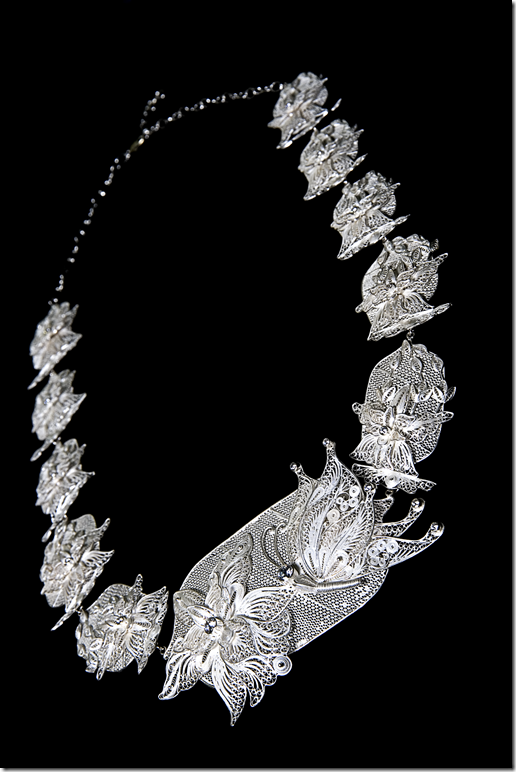
Her use of filigree in the work especially made for Welcome Signs demonstrates the capacity of silver to reflect the flowing organic forms of nature.

Grees Manupassa ‘Mighty Simplicity’ sterling silver 925 and circon (technic: joining and filigree; finishing: polishing), 2010

Grees Manupassa ‘Mighty Simplicity’ sterling silver 925 and circon (technic: joining and filigree; finishing: polishing), 2010

In her words:

‘The Mighty Simplicity’ is inspired by the well-known local wisdom of Indonesia with its friendly, pleasant and warm characteristics along with beauty of landscapes, cultures and traditions.

Floral arrangements such as jasmines and orchids are often used as welcome signs apart from being used as ornaments in many traditional rituals. This is why I chose these two flowers for my work; they have rare beauty, exotic look also as the icon of Indonesia’ natural wealth.

Within the whole production process that takes about one month long, I find out my own challenge in dealing with complicated yet exciting details. The traditional filigree technique was combined with some other techniques to bring out strong traditional elements in modern look.

I personally wish ‘The Mighty Simplicity’ could represent the civilization, beauty and warmth of Indonesia which is presented to those who are longing to visit Indonesia.

Yuri Kawanabe–weaving an Asian welcome in metal

Yuri Kawanabe 'Whirly halo neckpiece' (aluminium, silver 40 x 49 x 9 cm, 2004)

Yuri Kawanabe 'Whirly halo neckpiece' (aluminium, silver 40 x 49 x 9 cm, 2004)

Yuri Kawanabe constructing her work

Yuri Kawanabe constructing her work

I have always been fascinated by ceremonial displays of decorations handcrafted as though by magic. In my childhood, growing up in suburban Tokyo in the 1960s, I could still witness with excitement seasonal festivities with traditional decorations made from perishable materials like paper, straw, bamboo and other fresh plants. Over the years I have recognized that the aesthetic that I have been seeking through my art was actually rooted in these ephemeral creations.

In recent years, I have travelled to various regions in Asia and the Pacific including Tonga, Bali, China, Burma, Thailand, Vietnam, and India. There, I have encountered many ephemeral decorations made by locals for religious and seasonal occasions. I found a strong similarity to my own designs in those often modest, but meticulously crafted, ornaments. It is great to know that the skills to make these kinds of decorations have been passed from generation to generation and still survive today.

Ephemeral materials symbolically present a short-lived beauty of youth, purity and devotion. Fresh materials in vivid colours also retain (and conceal) tensions in their own forms. Thus in the early days (or hours) of a display, these perishable ornaments keep their strength within and make a striking impact on their viewers.

Yuri Kawanabe's photo from Bundi

Yuri Kawanabe's photo from Bundi

Intense contrasting colours dazzled me everywhere in India. At weddings, and in Hindu temples and festivals, everything and everyone seems to dress in almost iridescent hues. They look astonishingly beautiful and lively. The desire to adorn using the bright colours has been commonplace in many cultures worldwide, but no other culture than India seems to have such an eagerness to open the floodgates of colour.

I made the “Garland” series of anodised aluminium jewellery after an artist-in-residence stay in India. It was my attempt to generate a sort of visual “magnetism” by activating a field using bright contrasting colours. As in depictions of various idols, which are glorified with bright halos around them, the “Whirly Halo” neckpiece is designed to circle around a wearer’s head.

In a small northern town called Bundi, I was one of a few lucky tourists who happened to be there on the day of town’s annual festival. As a guest invited to the ceremony at the start of procession, I was presented with a beautiful garland. When the soft, fragrant string of flowers was placed around my neck by a young girl, I suddenly realised how honoured I felt. It was a gesture of welcome.

Yuri Kawanabe was born in Tokyo and completed a Master of Arts in ‘chokin’ (metalwork) at Tokyo University of Fine Arts. She moved to Australia in 1987, but retains strong ties to Japan and is involved in many exchange projects. Her works have been collected by museums including the National Museum of Modern Art, Tokyo, the Powerhouse Museum, Sydney, and Queensland Art Gallery, Brisbane.

Yuri Kawanabe is a participating artist in the Welcome Signs exhibition.

Sam Tho Duong – the private made public

Sam Tho Duong

Sam Tho Duong

When Sam Tho Duong was 14 years of age his family left Vietnam and settled in Pforzheim, the jewellery capital of Germany, if not the world. Sam was intrigued by the Goldstadt (Gold City) and began to study jewellery at the Technical College for Design of Jewelry & Objects. He took up a goldsmith apprenticeship with Dr.Wellendorff and then completed a diploma of design at University of Design, Pforzheim. Since he started as a freelance designer in 2002, he has shown his work in dozens of exhibitions, including six solo shows throughout Europe. In 2009 he won the prestigious Herbert-Hofmann-Prize for contemporary jewellery.

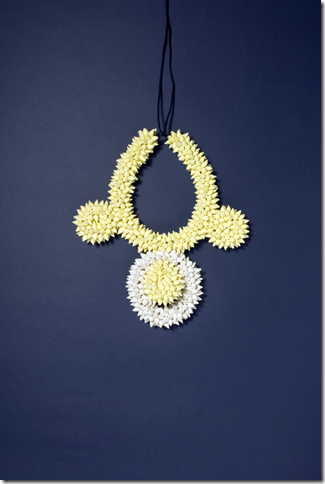
For Welcome Signs, he has contributed his work In der Ruhe Liegt die Kraft (In Silence lies Power). These include three ‘garlands’ modelled on traditional floral neckwreaths but made of toilet paper. The garlands are constructed by cutting white and yellow toilet paper into strips and rolling each piece in his fingers. These ‘paper pearls’ are then threaded on a steel string for permanence.

For Sam, the work reflects on the importance of the rest room as a sanctuary in our day. As modern people we depend on the regular supply of a material of which we remain silent, toilet paper, which Sam describes as ‘clean, soft and reliable. It deserves more than been flushed down the toilet.’

The contemporary jewellery movement has been largely defined as a challenge to traditional notions of preciousness. They sought to give value to jewellery not in the materials but through the ideas. Plastic could be just as beautiful  as gold, if designed with skill and imagination. This modernist challenge continues in Sam’s work, though he adds a critical edge in using a material that we normally keep out of sight.

So can we imagine a work like Sam’s ever being used as a welcome garland? Usually these garlands are made of material in public use, like flowers, money or confectionary. Can they be made from a material associated with private space? Or does their intrinsic beauty transcend all negative associations?

Sam Tho Duong 'Sanf & Sicher' (toiletpaper)

Sam Tho Duong 'Sanf & Sicher' (toiletpaper)

Sam Tho Duong 'Sanf & Sicher' (toiletpaper)

Sam Tho Duong 'Sanf & Sicher' (toiletpaper)

Sam Tho Duong is a participant in the Welcome Signs exhibition

Fran Allison–the lei of another land

Fran Allison

Fran Allison

Fran Allison is a New Zealand jeweller who interprets the ornamental traditions of her region within the context of her own cultural heritage.

Fran was born in New Zealand but graduated from Middlesex University and the Royal College of Art, London. She has shown her work in number of solo and group exhibitions including Assorted Titbits at the Dowse Art Museum and JOC (Jewellery Out of Context), which toured internationally. She currently lectures at Manukau Institue of Technology.

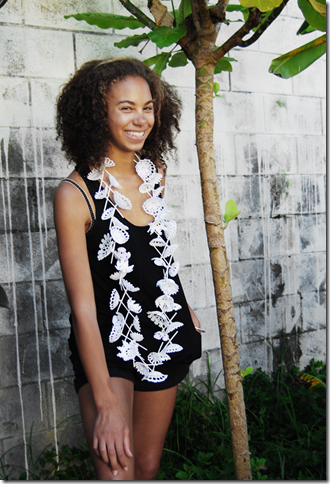
Her work for Welcome Signs is a Daisy Doily Chain, made from deconstructed crocheted white doilies collected from second hand shops. The daisy stems are made from lollipop sticks. According to Fran, ‘Each doily retains some trace of the women who lovingly crafted and used them.’

The daisy chain is one of the most common childhood encounters with the idea of jewellery. After romping through fields, children settle in a daisy patch and start making chains for each other by knotting their stems. Fran combines this game with the doily, which was one of the most common forms of needlework producing covers for household objects.

Living in the Pacific, Fran’s work also connects with the lei, the floral neck wreath used to honour guests. Fran’s Daisy Doily Chain creates a kind of lei for someone of European heritage (Pakeha) who is born in the Pacific.

Fran Allison 'Daisy Doily Chain' on France

Fran Allison 'Daisy Doily Chain' on France

Fran’s work will feature in the Welcome Signs exhibition.

Yu-Fang Chi – every body has a silver lining

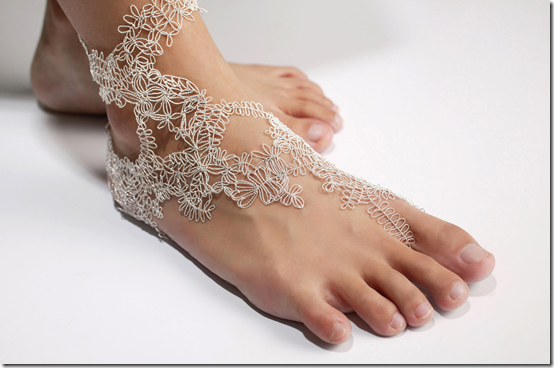
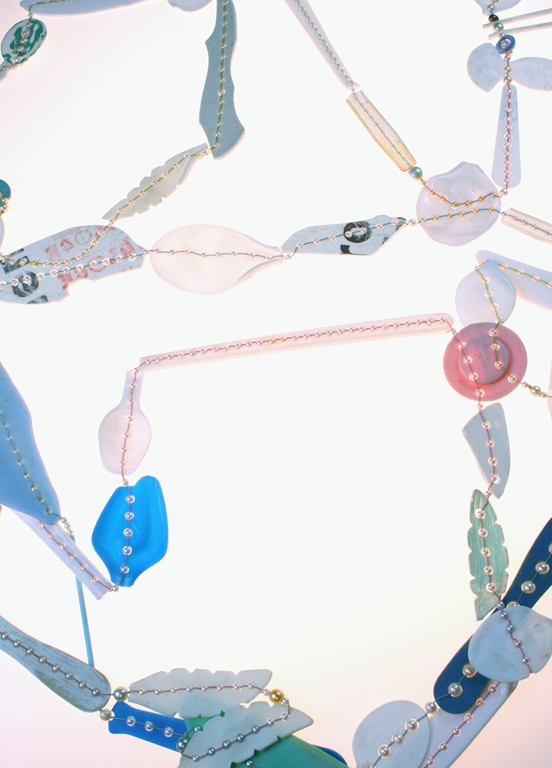
Yu-Fang Chi 'Laced with lace'

Yu-Fang Chi 'Laced with lace'

Yu-Fang Chi

Yu-Fang Chi

Yu-Fang Chi is a Taiwanese jeweller who studied metalsmithing at the Tainan National University of The Arts. She has been represented in a number of international exhibitions, including Schmuck and Talente, Korea and Japan. She is currently a lecturer in the Department of Art and Design, National Hsinchu University of Education.

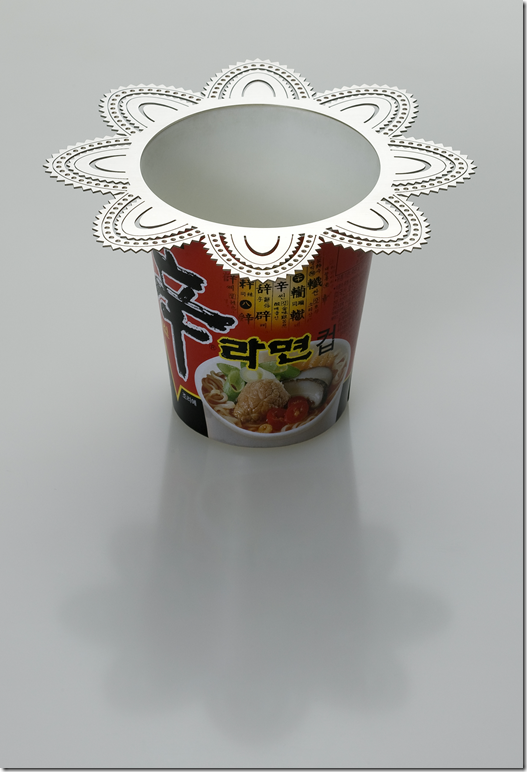
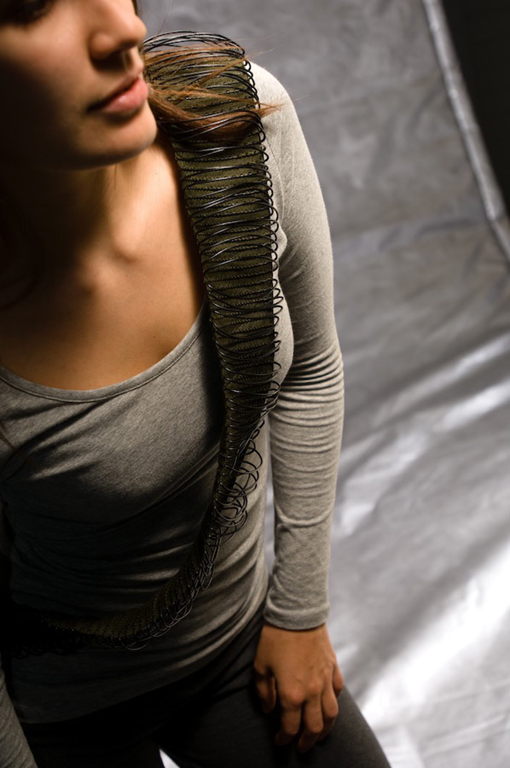
Her series ‘Laced with Lace’ involves delicate silverwork that forms organic like patterns that drape over parts of the body. Chi’s work explores the space between the body and jewellery by creating work that does not obviously attach to the body as a foreign object. Her work follows the natural contours of the body as though it patterns the skin itself.

Chi’s work reflects an experimentation with form and content, applying a technique associated with needlework to metalsmithing. The result has the kind of easeful grace that we might associated with the floral garland. But its ephemerality is also a challenge. Like the traditional garland, does the fragility of this lace work limit its durability?

Chi reflects on the work in her own words:

In contrast to classical lace, objects in the “Laced with Lace” series do not have dyed or inlaid borders surrounding a central body of work. Rather these pieces are a natural extension of closeness, radiating outwards from spaces and holes at the corners and seams, following the joints and hugging the body. Through this light and fine “layer” the physical form is part of an intriguing mixture – actively “wearing” and passively being “embraced.” Without a central motif, the objects are partial forms that can be used to reflect on the past, similar to the interrelationship of the skin and the organs, alluding to the certain area of the body. – Shoulders? Wrists? Chest? Posterior? The light, mobile nature of the lace skin evolves from being merely a display, into something that is glimmering and alluring. Viewers focus on and are soon lost in the complex and difficult to understand lattice work, with no single thing on which to focus or reflect. The soaring, extending pattern causes one’s line of vision to move rapidly. Within this flattened visual experience, patterns, totems and messages are removed for a more visually stunning effect without feeling or name.

Yu-Fang Chi 'Laced with lace'

Yu-Fang Chi 'Laced with lace'

Yu-Fang Chi is one of the participating artists in the Welcome Signs exhibition

Vinit Koosolmanomai – jewellery for the blind

Vinit Koosolmanomai

Vinit Koosolmanomai

Vinit Koosolmanomai studied jewellery at the Asian Institute of Gemological Sciences, in Bangkok. He then travelled to San Francisco where he took specialist workshops at the Revere Academy of Jewelry Art.

For Welcome Signs, Vinit has produced a series of necklaces that are designed to be worn by blind people. For this, he has focused on the quality of sound – a dimension not often considered in jewellery. He has created necklaces made from tiny bells of many colours woven together.

The idea came to him while playing with bells in his studio. To realise the project, Vinit worked with an organisation for the blind called Kow-Mai, which means ‘new step’. Photographs of blind people wearing the necklaces were taken by his associated Pichai. The necklaces are then exhibited alongside the photographs and all money from sales is returned to the organisation. According to Vinit, the participants enjoyed the sounds of the necklace greatly, but also wanted information about how they looked as well, even if this wasn’t something they could experience directly.

According to Vinit, ‘the important thing is to let them know that people still care about them.’ In the context of Welcome Signs, Vinit’s work asks the interesting question of how we make welcome those who can never fully belong to the same world.

In Thai culture, the phuang malai is a floral garland that symbolises beauty and respect. While blind persons can smell the jasmine scent, they are unable to enjoy its visual beauty. Vinit has given a new dimension to the garland with the addition of sound. It also makes us ask some important questions:
  • What is the ongoing role of the participants? We get to see images of them wearing the work, but what do they get from us?

Vinit provides a broader audience with a taste of the new contemporary jewellery emerging from Thailand. If Vinit’s work is anything to go by, then we might expect new work that approaches jewellery from left field, probing its shared value. According to Vinit; ‘My interest in jewellery comes from my surprise that people would like to wear jewellery. In some cases, they have to experience pain before they can wear jewellery.’ Thai jewellery is bound to surprise.

For more contemporary Thai jewellery, visit Atta Gallery.

Vinit Koosolmanomai jewellery worn by participants in his project

Vinit Koosolmanomai jewellery worn by participants in his project

Vinit Koosolmanomai’s work will be on display in Welcome Signs: Contemporary Interpretations of the Garland.

A Sumba welcome–by Fryza Pavitta

Sumbanese Contemporary Narrative Jewellery by Fryza Pavitta

Sumbanese Contemporary Narrative Jewellery by Fryza Pavitta

Fryza Pavitta is an Indonesian jewellery designer currently based in Jakarta. She was born in Samarinda, East Kalimantan. She studied Industrial Design at Bandung Institute of Technology, where she developed a number of jewellery pieces including Zapp, which was a knife turned into a necklace.

She also developed a work of ‘distributed jewellery’ titled Sumbanese Contemporary Narrative Jewellery. The work includes symbols from Sumba culture about mythological forces of earth and sky. According to Fryza:

For Sumbanese, the sky is filled with ‘star dust’, made from souls of ancestors that look down on the living, offering rain as a blessing. This is represented by the silver chain. The earth is a female figure, represented in the U shape of a bowl, filled by the rain. On this are various shapes including living creatures and the omega symbol of woman. Finally there is the level of the sea, which represents potential loss.

Women’s activity is particularly important in this mythology. The weaving of the tenun ikat is symbolic of the string that ties the earth and sky together.

The piece itself is strung together. Components can be detached. The piece is designed to be distributed among others.

Since graduating from Bandung, Fryza worked for several months in Geoti Studio, designing sculptural objects from an ashtray to a city park. With others, she has also shown work about the wedding ring and the hand gestures of a married couple.

Back in Jakarta, she now works for the industrial designer Leonard Theosabrata. She plans to continue with jewellery.

This work will feature in the Welcome Signs exhibition. It’s an interesting example of how the jewellery object can carry a story that connects people together. We can only imagine the very special situation in which it is used and the continuing connection that its owners will experience.

How Jayne Wallace helps unlock the past

Jayne Wallace 'Jewellery Box, My Dresses Brooch', 2010, photo by Bill Shaylor

Jayne Wallace 'Jewellery Box, My Dresses Brooch', 2010, photo by Bill Shaylor

One of the works for the Signs of Change exhibition as a jewellery box by Jayne Wallace designed as a memory prompt for those in the early stages of dementia. As a work of functional jewellery, it demonstrates how the intimacy of ornament can provide a powerful stimulus for recovering memory.

She spend a long time with her participants exploring their memories and how they might be triggered. This includes use of a camera, soft clay, prize rosettes, preserve jars, seed packets, dress patterns, pearls of wisdom and a ‘self-tree’. From these exercises, Jayne was able to fashion objects that could evoke strong past memories.

How did you become involved in the memory project?

The relationship between memory and jewellery has always been fascinating to me. We use jewellery objects as vessels so often – to hold memories, as objects to pour our feelings into about an associated ‘other’ be that a person, place, experience… or as comforters – something that connects us to other people or is comforting because it has physically accompanied us through our experiences. The nature of jewellery as such means it has rich potential when we think about ways to help someone hold on to or share aspects of their experiences – this relates to all of us – and naturally suggests people who are experiencing difficulties in doing this. To this end we wanted to work with people who were living with dementia and their close friends/family to make pieces of jewellery that could potentially help them share aspects of past and current experience and hopefully hold on to these over time.

Have you found out how the memory box has been working with Gillian and her family?

They have used the box to record music to each of the dress fabrics – music from the holiday when the dress was worn etc and are using the fabrics and songs as stimuli for further conversation and reminiscing to also record to the box. You’ll see from the film that the dress fabrics also prompted memories about the letters they used to write to one another when they were courting and they have been re reading these and storing those in the box too.

See a film with the participants in this project, Gillian and John.

Some other memory pieces by Jayne Wallace include:

Jayne Wallace 'A locket that can forget' (image degrades a little each time it is opened)

Jayne Wallace 'A locket that can forget' (image degrades a little each time it is opened)

Jayne Wallace is Research associate on the Newcastle University Digital Research Hub, centring on social inclusion in the digital economy. For more information, visit her website

Katheryn Leopoldseder’s ‘For God so loved the world…’

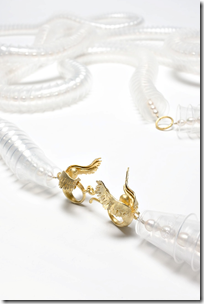
Katheryn Leopoldseder ' For God so loved the world...(70 x 7 Used, Disposable Communion Cup Necklace)' 490 recycled communion cups, fresh water pearls, 18ct gold, Gold plated sterling silver, stainless steel, 2008, 260cmL x 8cmW x 3cmH, photograph by Jeremy Dillon

Katheryn Leopoldseder ' For God so loved the world...(70 x 7 Used, Disposable Communion Cup Necklace)' 490 recycled communion cups, fresh water pearls, 18ct gold, Gold plated sterling silver, stainless steel, 2008, 260cmL x 8cmW x 3cmH, photograph by Jeremy Dillon

Katheryn Leopoldseder is a Melbourne jeweller who came through RMIT Gold & Silversmithing and now works at Abbotsford Convent, in a shared studio with Phoebe Porter.

While supplying e.g.etal with quality production jewellery, she has also managed to produce epic jewellery works for exhibition. In her six years since graduation, Leopoldseder has shown a capacity to wreak weighty themes from what might otherwise seem a purely ornamental medium like jewellery.

Her work is disarmingly ambivalent. She manages to express great beauty in what appears to be the wastefulness of much contemporary life. Recently she produced an elaborate pendant in the shape of lungs beautifully punctuated with white cigarette filters.

Her work for Welcome Signs is ‘For God so loved the world…’ It features 490 tiny plastic communion cups threaded in a necklace with pearls. Leopoldseder collected these cups from a church she attended, reflecting on the contradiction between the sacred ritual and its profane outcome. For her, it was…

an acknowledgement of how far we fall, that even within this most sacred and enduring of rituals we have somewhat missed the point. Morphing communion into a convenient, disposable, individual, sanitized and, I believe irresponsibly wasteful version of its former self.

The necklace is joined by a clasp in the shape of K’ruvim, as angels are known in the Hebrew story of the covenent. She quotes the Bible:

He (B’tzal’el) made the arc of pure gold,…. He made two k’ruvim of gold: he made them of hammered work for the two ends of the arc cover – one keruv for one end and one for the other end; he made the k’ruvim of one piece with the arc-cover at its two ends. the k’ruvim had their wings spread above, so that their wings covered the arc; their faces were toward each other and toward the arc cover. – Exodus 37: 6 – 9 Complete Jewish bible

Katheryn Leopoldseder ' For God so loved the world...(70 x 7 Used, Disposable Communion Cup Necklace)' 490 recycled communion cups, fresh water pearls, 18ct gold, Gold plated sterling silver, stainless steel, 2008, 260cmL x 8cmW x 3cmH, photograph by Jeremy Dillon

Katheryn Leopoldseder ' For God so loved the world...(70 x 7 Used, Disposable Communion Cup Necklace)' 490 recycled communion cups, fresh water pearls, 18ct gold, Gold plated sterling silver, stainless steel, 2008, 260cmL x 8cmW x 3cmH, photograph by Jeremy Dillon

The number 7 x 70 of cups corresponds with a later Biblical story:

Then Kefa came up and said to him (Jesus), “Rabbi, how often can my brother sin against me and I have to forgive him? As many as seven times?” “No, not seven times,” answered Yeshua, “but seventy times seven!” – Mathew 18:21-22 Complete Jewish Bible

An important element of this work is the way it leaves its references incomplete. Rather than the whole angel, only the wings feature on the clasp. And the title, engraved in the first cup, only hints at the complete quote:

For God so loved the world that he gave his one and only Son, so that everyone who believes in him will not perish but have eternal life.-John 3:16

It is quite unusual today to find jewellery based on religious meaning, despite the strong history of association. There’s a danger that it might limit the interest in the way to those of the same faith.

While ‘For God so loved the world…’ does certainly respond to particular Christian themes, I think it also has a broader appeal. The need to care for the planet has become a sacred cause in contemporary life, yet there is little formal structure to underpin this value. Is environmentalism a matter of enjoying our time on the planet a little longer, or does it rest on a deeper sense of ourselves as custodians of something greater? These are questions left unanswered by contemporary politics. While I don’t think this work provides an answer, it does ask the question.

In relation to Welcome Signs, Leopoldseder’s work engages with the history of the garlands as a ritual neckpiece that mark important occasions. While we might have taken for granted the abundance of nature in supplying the materials for these garlands, today we are alerted to the sacrifices that attend any celebration. Hers is a garland for our fraught times.